A recent analysis of 3 64 U.S. metropolitan areas found that falling mortgage rates may not be enough to create a broad affordability reset in many markets. At the 6.49% benchmark, 316 of the 364 metros analyzed—or 86.8%—were unaffordable for the median-income household based on a standardized 30% housing-cost ceiling.
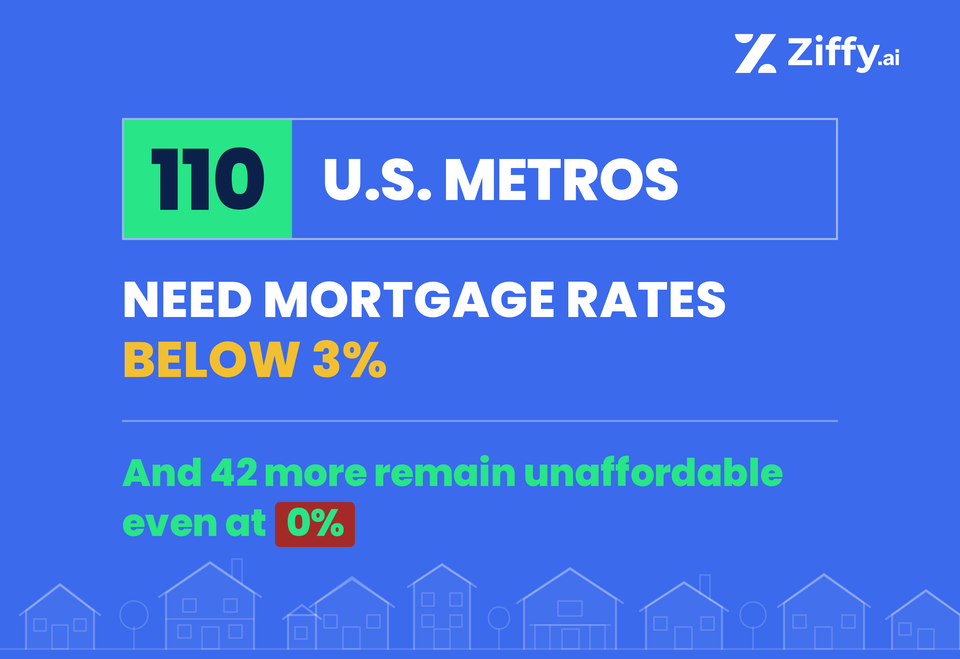
The research identified significant disparities in how mortgage rate changes impact different regions. While some markets would see improved affordability with modest declines, 152 metros would remain above the modeled affordability threshold even if rates dropped to 3%. This group includes 42 metros where no nonnegative mortgage rate can close the gap because the cost of principal, property tax, and insurance already exceeds 30% of median gross monthly income.
In California, the study found that none of the state's 24 eligible metros were affordable at a 6.49% rate. Notable markets such as Los Angeles, San Francisco, San Diego, and San Jose all fell into categories where no positive rate-only solution exists. In Los Angeles, repaying the mortgage principal alone cost approximately $2,444 per month, which exceeded the affordability ceiling of $2,410.
Other states showed varying levels of sensitivity to rate changes. In Florida, all 22 eligible metros were unaffordable at 6.49%, though Miami required a much lower rate of 1.36% compared to Tampa and Orlando, which required rates above 3%.
The analysis also highlighted markets that are closest to achieving affordability. Indianapolis was identified as a major metro where a relatively small decline would change the outcome, requiring a rate of approximately 6.21%. Other large metros showing more manageable gaps included San Antonio, Philadelphia, Chicago, Houston, Minneapolis, Washington, D.C., Atlanta, and Dallas.
Conversely, some of the largest price gaps were observed in California markets. The study noted that in Santa Maria–Santa Barbara, the modeled price gap reached 78.6%. In these high-cost areas, even a hypothetical 0% interest rate does not resolve the mismatch between median listing prices and median household incomes.
The study's methodology used 2024 American Community Survey income estimates and June 2026 median listing prices. The affordability model assumed a 20% down payment, a 30-year fixed-rate term, property taxes equal to 1.1% of the listing price, and homeowners insurance equal to 0.5% of the listing price. The findings were based on a primary ranking of 364 stateside metros with at least 200 active listings.