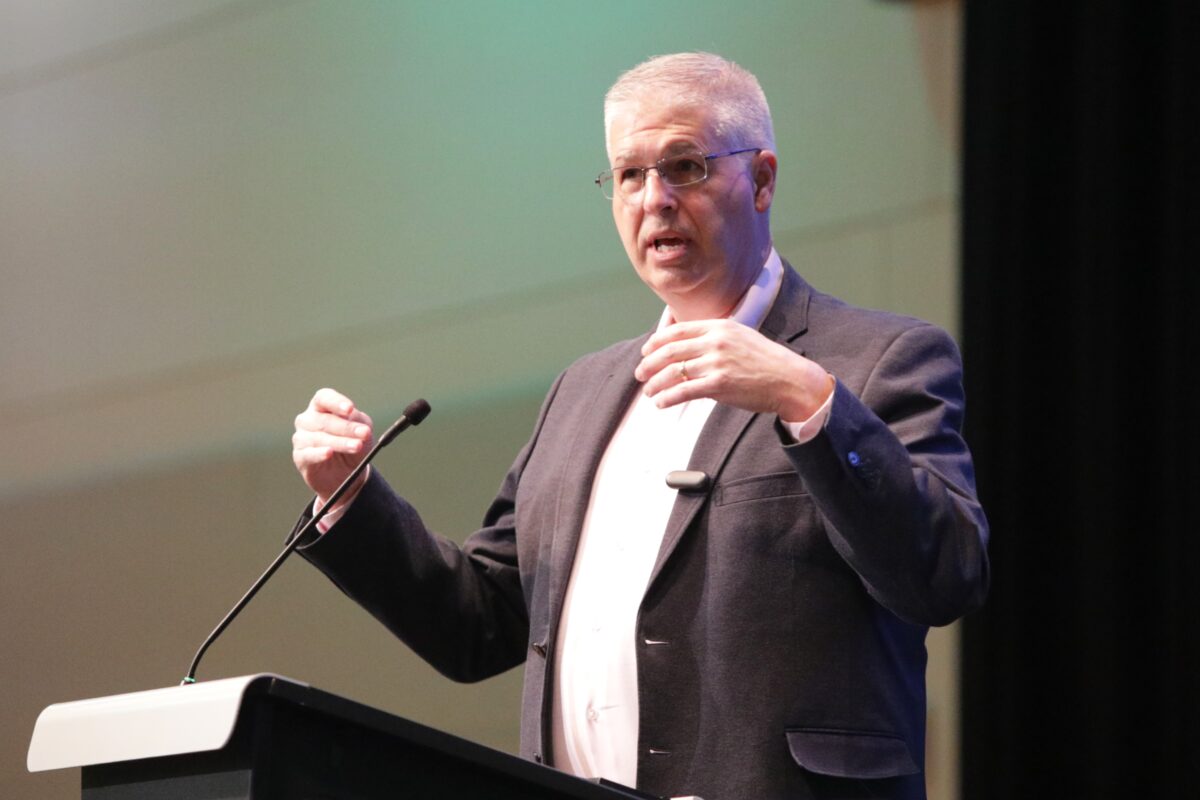
Business and government leaders gathered Thursday, Nov. 12, 2026, to address community growth challenges at the Utah Valley Chamber of Commerce Growth and Prosperity Summit in Orem. The event brought together experts to discuss how county leadership can foster prosperity while managing the impacts of rapid development.
The summit featured presentations from 43 experts in various fields regarding theories on fostering community prosperity. UV Chamber President Curtis Blair said the summit provided action items for community members to implement in their businesses, homes, and communities.
Conversations during the summit involved how the county can best preserve water reserves, welcome innovative energy solutions, and manage infrastructure, according to Blair.
Charles Marohn, an urban planner, civil engineer, and founder of Strong Towns, served as the concluding keynote speaker. Marohn suggested that Utah County leaders should identify ways to make better use of existing community resources rather than focusing on outward expansion.
Marohn stated that post-World War II outward city expansion has led to infrastructure costs that a city's tax base cannot support, causing cities across the country, including in Utah, to spiral into debt. He noted that building more can create more problems and argued that the only way to solve the math problem of unmaintainable infrastructure is to make better use of what has already been built.
To lower the bar of entry for community participation, Marohn proposed building more starter homes, offering affordable business opportunities, and removing red tape in the development process.
Blair noted that while not all of Marohn's proposals may apply to Utah Valley, many can be considered to maintain and preserve quality of life. Blair pointed to the opening of farmers markets throughout the county as an example of giving small businesses opportunities.
The summit follows projections from the Ken C. Gardner Policy Institute stating that Utah County will experience the state's fastest job growth over the next 40 years, backed by a young, growing population. Since 2020, the county has added 101,257 residents, bringing challenges related to housing, transportation, energy, and water due to commercial and residential development.