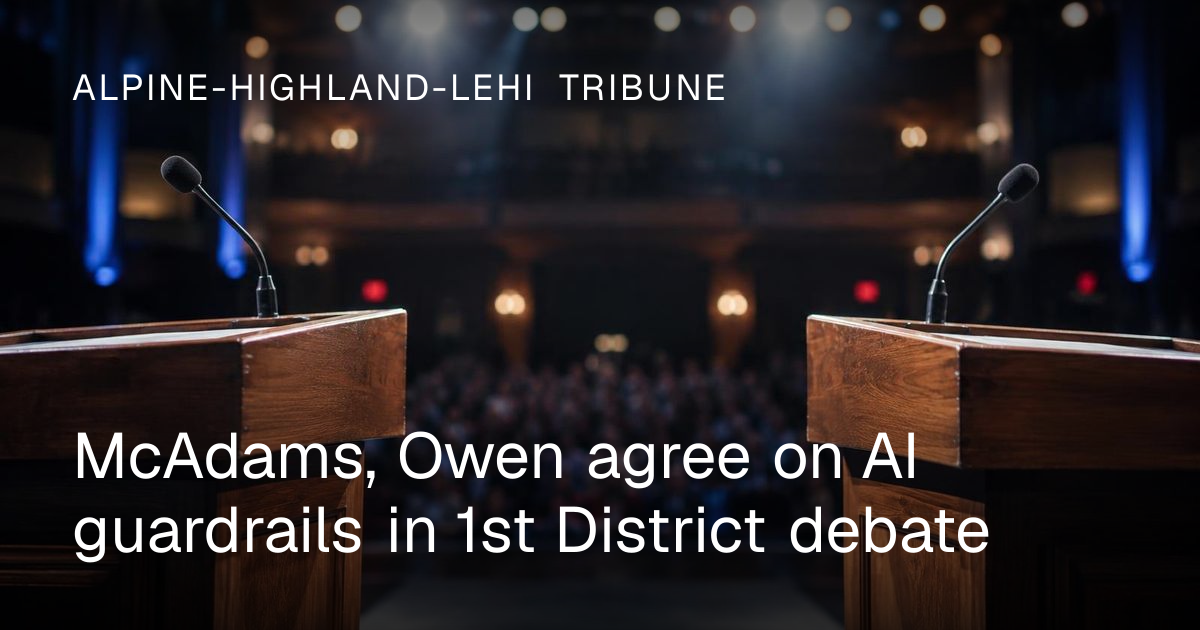
Democrat Ben McAdams and Republican Riley Owen reached an agreement on federal artificial intelligence regulation and water-positive requirements for data centers during their first debate for Utah's 1st Congressional District. The hour-long exchange took place on Tuesday, Sept. 29, at Salt Lake Community College, covering topics such as the Great Salt Lake and Social Security, according to a report published October 1.
During the debate organized by the Utah Debate Commission, both candidates advocated for specific oversight regarding technology and infrastructure. Owen, a Navy Reserve intelligence officer and former White House policy analyst, stated that developers must pay taxes, be carbon negative, be water positive, and avoid damaging the grid or the land. McAdams, a former U.S. representative and Salt Lake County mayor, said data center projects must contribute water to the system and not rely on government subsidies, emphasizing that they should never take away from the Great Salt Lake watershed.
The candidates offered different perspectives on artificial intelligence and Social Security. McAdams called for strong federal guardrails, noting that Congress has not yet ensured AI benefits all Americans rather than just tech billionaires. Owen described AI as the single greatest issue facing Americans for decades to come. Regarding Social Security, McAdams proposed lifting the payroll cap for those earning above $350,000, while Owen suggested investing Social Security funds in the stock market. Neither candidate proposed cuts to retirement benefits.
The candidates also differed on the management of the Great Salt Lake. McAdams criticized the state for not doing enough and suggested acquiring water rights to redirect flow from rapid growth. Owen stated the state is on the right track but argued that federal funding and aggressive modernization of water infrastructure, including leasing water rights and removing invasive plants, are essential.
Data center development has become a major political issue in Utah. A Deseret News and Hinckley Institute of Politics poll conducted Sept. 10–15 among 744 registered voters found that 67% of Utahns preferred protecting communities from data centers over building them to compete with China. Meanwhile, on Sept. 30, the U.S. Senate failed to pass a procedural vote for the Ratepayer Protection Act, a bill intended to shield taxpayers from data center grid-upgrade costs, with the vote falling 57-43.
The general election is scheduled for Nov. 3. No second debate has been announced.