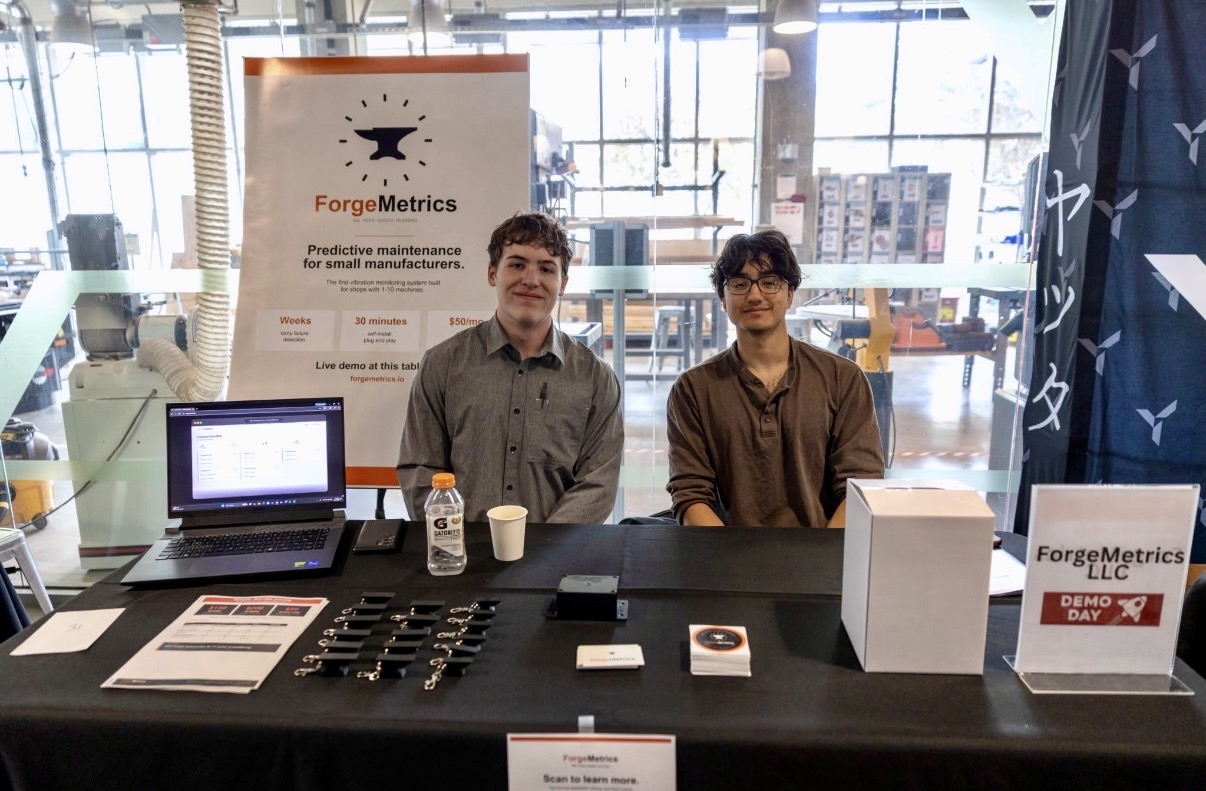
Two biology majors, Dominic Gaviglio and Richard Ji, are developing ForgeMetrics, a predictive maintenance platform designed to help manufacturers detect machine failures before they occur. According to a report published October 16, the startup uses wireless vibration sensors and artificial intelligence to assist businesses in avoiding costly downtime.
ForgeMetrics is designed specifically for computer numerical control (CNC) mills and lathes used in manufacturing shops. The system monitors the spindle to identify abnormal vibration patterns that could indicate mechanical issues. Gaviglio noted that a single machine failure can cost a company between $15,000 and $40,000 in repairs and lost productivity. He stated that the system acts like insurance for small businesses, noting that one breakdown can pay for the system's cost for ten years.
The concept for the company originated after a friend's family experienced an unexpected CNC machine failure. Following months of research, Gaviglio and Ji discovered that while large factories use predictive maintenance, a gap existed for smaller manufacturers. To validate the market, Gaviglio visited nearly 50 manufacturing shops throughout the Salt Lake Valley to ask owners about the necessity of an affordable system.
The development process involved significant technical challenges, including a completely failed first prototype and connectivity issues with a second prototype. Ji, despite having no formal engineering background, taught himself engineering and circuit board design to build the wireless sensor, software dashboard, and machine-learning algorithms. Gaviglio focused on sales, business development, and customer research.
The founders credit the Lassonde Entrepreneur Institute with helping advance ForgeMetrics. After reaching the Top 8 teams in the Tim Draper Utah Entrepreneur Challenge, the company received a $2,500 grant. Gaviglio also mentioned that mentorship from Scott Holley provided valuable professional connections.
The company has finalized its third prototype and is currently in the fabrication stage. A pilot deployment is scheduled for this summer, with the goal of being fully functional by late summer before entering commercial testing. The founders also plan to participate in the Lassonde Company Launch program to pursue FCC certification and prepare for a commercial launch.