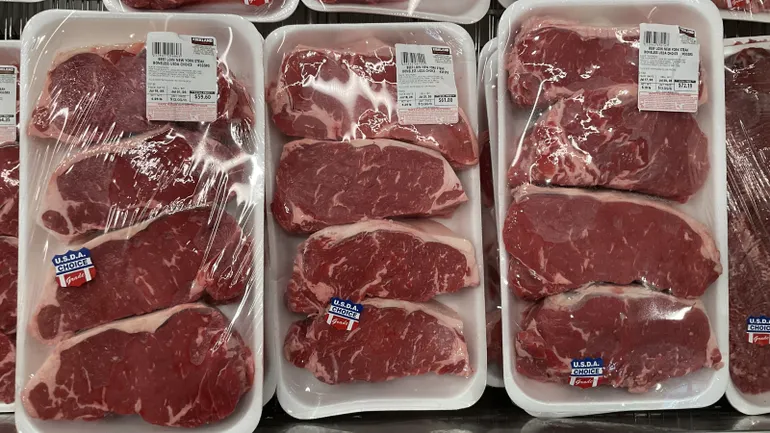
Grocery inflation rose 0.4% in October 2026, marking the largest month-to-month increase in food-at-home prices since April, according to Consumer Price Index data published Tuesday by the U.S. Bureau of Labor Statistics. The rise was primarily driven by surging costs for fresh vegetables and meat products, even as coffee and fresh fruit prices saw declines.
Produce and Meat Drive Inflation
Produce and meat served as the primary contributors to the October uptick in grocery costs. Prices for fresh vegetables surged more than 2% last month, with specific categories seeing dramatic shifts: lettuce prices leapt almost 8%, tomato prices grew about 2%, and potato prices rose nearly 1%. In contrast, fresh fruit prices trended downward, as apple prices fell by 1.6% and banana prices declined by a fraction of a percent.
Meat and Poultry Trends
Meat prices continued an upward trend through October. Uncooked beef steak prices rose by almost 2%, while prices for uncooked ground beef and sausage products increased by approximately 1%. Poultry prices also added nearly 1% to the total, though ham prices saw a similar percentage decrease. The Food Industry Association noted Tuesday that retailers and suppliers are beginning to pass rising costs to consumers, a trend predicted in September.
Impact of Rising Fuel Costs
The rise in food costs is linked to broader economic factors, including elevated fuel expenses. As of Monday, the average price for a gallon of diesel was $6.13, a 60% increase from the $3.84 per gallon recorded a year ago, according to the U.S. Energy Information Administration. Andy Harig, vice president of tax, trade, sustainability and policy development for the Food Industry Association, stated that higher diesel costs are ultimately reflected in food production and delivery, a process that can take months to manifest in grocery prices.
Historical Inflation Context
Data from the U.S. Bureau of Labor Statistics shows that while October saw a 0.4% increase, the broader food-at-home Consumer Price Index (CPI) had previously grown 0.1% from August 2026 to September 2026. The USDA's Economic Research Service reported that food prices in September 2026 were 1.8% higher than they were in September 2025. This follows a pattern of varied inflation rates throughout 2026, which saw grocery inflation slow in May and June before declining slightly in July and September.
Long-term Food Price Forecasts
The USDA's October 2026 Food Price Outlook provides long-term forecasts for various food categories. The agency projects that food-at-home prices will increase by 2.3% in 2026, with a forecast interval between 1.9% and 2.7%. Looking further ahead, the agency forecasts a 1.0% increase for food-at-home prices in 2027. While some categories like beef and veal are expected to see significant annual growth, others like eggs and dairy are projected to decline in 2026 compared to 2025.
Commodity-Specific Projections
Specific commodity forecasts from the USDA highlight significant volatility. Beef and veal prices are forecast to increase 8.7% in 2026, despite a 1.3% decrease in prices from August 2026 to September 2026. Egg prices, which fell 20.6% in September 2026 compared to September 2025, are forecast to decrease 29.3% in 2026. This decline is attributed to a projected increase in egg production and a reduction in new detections of Highly Pathogenic Avian Influenza (HPAI) compared to the first quarter of 2025.
Regional Cost of Living Comparison
The cost of living remains a significant factor across various U.S. regions. According to Numbeo's 2026 mid-year rankings, Salt Lake City, Utah, maintains a cost of living index of 66.7. In comparison, highly expensive metropolitan areas like New York, NY, sit at an index of 100.0, while Honolulu, HI, follows closely with an index of 98.2.