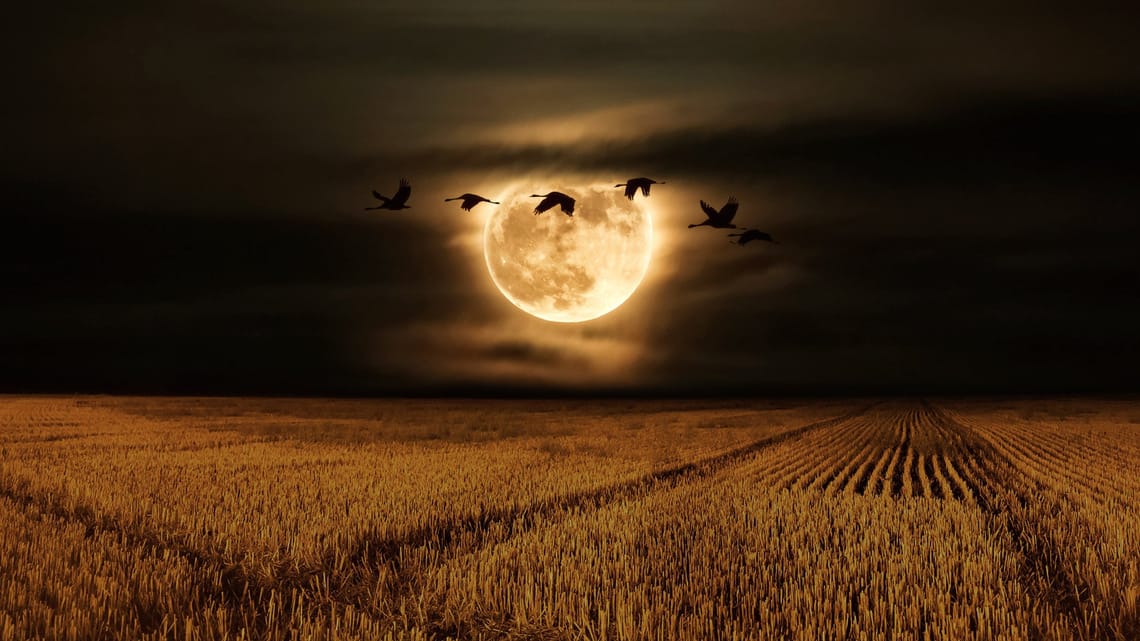
The October Full Moon, traditionally known in the Northern Hemisphere as the Hunter's Moon, is scheduled to reach its peak on Monday, October 26, 2026, at 04:12 GMT/UTC. Positioned within the Aries constellation, the moon will appear bright and round to observers for several nights between October 25 and October 27.
Celestial Positioning and Appearance
The lunar event is characterized by its placement near the stars Sheratan and Hamal. While the moon enters the Aries constellation shortly before reaching its full phase, astrological interpretations describe the Hunter's Moon as a Full Moon in the sign of Taurus. This distinction arises because astrological signs divide the ecliptic into twelve fixed sectors, whereas astronomical constellations consist of irregular regions with official boundaries.
Observers can expect the moon to rise near the eastern horizon around sunset and set near the western horizon around sunrise. When viewed near the horizon, the moon may appear gold, orange, or reddish due to its light traveling through more of Earth's atmosphere. This phenomenon, along with the Moon illusion, can make the lunar disk appear unusually large beside distant hills, buildings, or trees.
Planetary and Stellar Alignments
A notable celestial alignment will occur on the evening of October 25 and into the night of October 2526. During this period, the nearly full moon, the planet Saturn, and the star Algenib will form a large, nearly equilateral triangle.
While both the moon and Saturn are easily visible to the naked eye, the brightness of the moonlight may make the star Algenib more difficult to observe. Using binoculars may help reveal the star, which has a magnitude of 2.8. Additionally, at the exact moment of the full moon on October 26, the stars Sheratan and Hamal will appear approximately 4 degrees and 7 degrees from the lunar disk, respectively.
Lunar Cycle and Observing Conditions
The Hunter's Moon serves as the first full moon following the Harvest Moon. For those tracking lunar phases throughout the month, the moon reached its new phase on October 10 at 15:50 GMT/UTC. During that period, the moon's illuminated side faced away from Earth, making it invisible and providing an ideal window for deep-sky observing of objects like the Saturn Nebula or the Andromeda Galaxy.
Other key lunar phases for October 2026 include the last quarter, which occurred on October 3 at 13:25 GMT/UTC, and the first quarter, which occurred on October 18 at 16:13 GMT/UTC.
Global Timing and Observations
The timing of the peak full moon varies by global location. In North America, for instance, Los Angeles will experience the full moon on the evening of October 25 at 9:12 PM PDT. In contrast, the peak occurs on October 26 in Europe, Africa, Asia, and eastern North America, with specific times recorded as 04:12 GMT/UTC in London, 05:12 CET in Paris, 12:12 CST in Beijing, and 13:12 JST in Tokyo.
Tracking the Lunar Path
To track the moon's movement, observers can use tools like the Sky Tonight app, which allows users to view the lunar phase for any given day, along with the moon's apparent size and orientation relative to their specific location. This technology can help users identify nearby celestial objects and track the moon from its waning phases through the new moon and back to a waning gibbous.