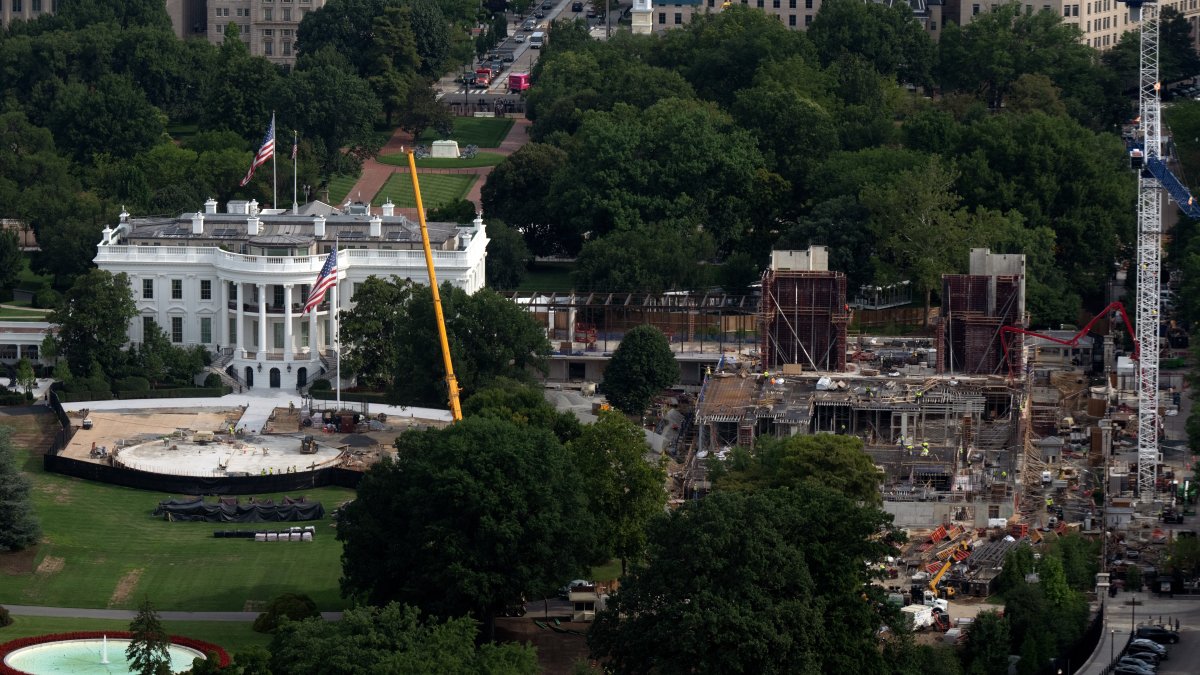
A court of appeals ruled on Friday that the administration of President Donald Trump must stop the construction of a $400 million ballroom at the White House until it receives approval from Congress, according to a report published August 7.
A three-judge panel for the United States Court of Appeals for the District of Columbia determined that the president lacks the individual authority to construct the 8,400 square meter ballroom on the site where the East Wing previously stood before its demolition was ordered.
In a resolution with two votes in favor and one against, the court sided with historical preservation advocates who filed a lawsuit to halt the construction. However, the court indicated it will suspend the execution of its ruling for two weeks to allow the government to appeal to the Supreme Court.
The ruling stated that the decision of whether or not a large ballroom should be built is a matter for Congress to decide and is not a matter for the Executive Branch to act upon independently. The court noted that the ruling does not address whether the proposed ballroom is desirable as a matter of public policy, nor does it necessarily mean the defendants cannot ultimately build the ballroom.
The panel reaffirmed an April 16 order from federal district judge Richard Leon to halt surface-level construction of the ballroom. Judge Leon had previously allowed underground work, such as a bunker and other projected national security facilities, to continue.
The National Trust for Historic Preservation filed the lawsuit to challenge the project in December 2025, one week after the White House finished demolishing the East Wing to make room for the ballroom, which Trump stated could hold 999 people.
Government lawyers argued that the project, described as the largest structural change to the White House in over 70 years, includes critical security features against threats such as ballistic missiles, drones, and biological risks. They stated that these improvements are essential to protect the president, his family, and staff.
Lawyers for the preservation group responded that the absence of a ballroom in the White House does not constitute a national security emergency.
The case was assigned to judges Patricia Millett, Neomi Rao, and Bradley Garcia. Millett and Garcia supported the decision, while Rao dissented.
On April 2, the project received final approval from the 12-member Commission of Fine Arts, which is responsible for approving construction on federal property in the Washington region.