Artist Cole Eisenhour has begun painting a large-scale mural on the Multi-Ethnic Senior Highrise to bring visual recognition back to Salt Lake City's historic Japantown, a project designed to honor a community once devastated by mid-century urban renewal. The mural, located on 100 South, uses themes of resilience to bridge the neighborhood's fractured history with its future.
Artistry Rooted in Resilience
The mural project, which began with community members painting design elements during the Salt Lake Buddhist Temple’s Obon Festival on July 11, 2026, serves as a visible first phase of a larger redevelopment plan. Funded by the Community Reinvestment Agency and the Salt Lake City Public Art Program, the work is being executed on the north-facing wall of the Multi-Ethnic Senior Highrise (MESH), a building that Japanese American organizers spent a decade fighting to construct following the initial destruction of the neighborhood.
Eisenhour, a Northern Utah muralist who studied at Utah Valley University, was selected through a process led by the community-based Japantown Art Committee. The committee, which included Troy Watanabe, Jean Tokuda Irwin, Liz Ward, and Cindy Yamada Thomas, chose Eisenhour from four finalists within the Public Art Program’s 2026–2028 Pre-Qualified Artist Pool. The artist was first introduced to the neighborhood during the Nihon Matsuri on April 25, 2026, where he engaged directly with local residents to help shape the design.
Visualizing a Fractured History
The visual design of the mural draws heavily on kintsugi, the Japanese practice of repairing broken pottery with gold to highlight rather than hide cracks. Eisenhour described the work as a "visual diary," utilizing interconnected panels to tell the story of Japantown. The design features black-and-white archival faces rising from a gold crack that splits the pink concrete, framed by deep blue asanoha and red seigaiha wave patterns.
According to the Salt Lake City Arts Council, the imagery is intended to weave together references to the incarceration of Japanese Americans at the Topaz War Relocation Center in central Utah, cultural traditions, and the lives of community figures. By using the kintsugi metaphor, the mural aims to transform the history of a broken neighborhood into a symbol of strength and continuity, reflecting the ethos of Okage sama de—“I am who I am because of you.”
Redevelopment and Olympic Pressure
The current revitalization efforts arrive at a time when the remaining fragments of Japantown face renewed pressure from large-scale urban redevelopment. While a 2021 Japantown Design Strategy previously proposed improvements like wider sidewalks, cherry trees, and cultural markers, those plans are currently paused as the city awaits the resolution of larger regional projects.
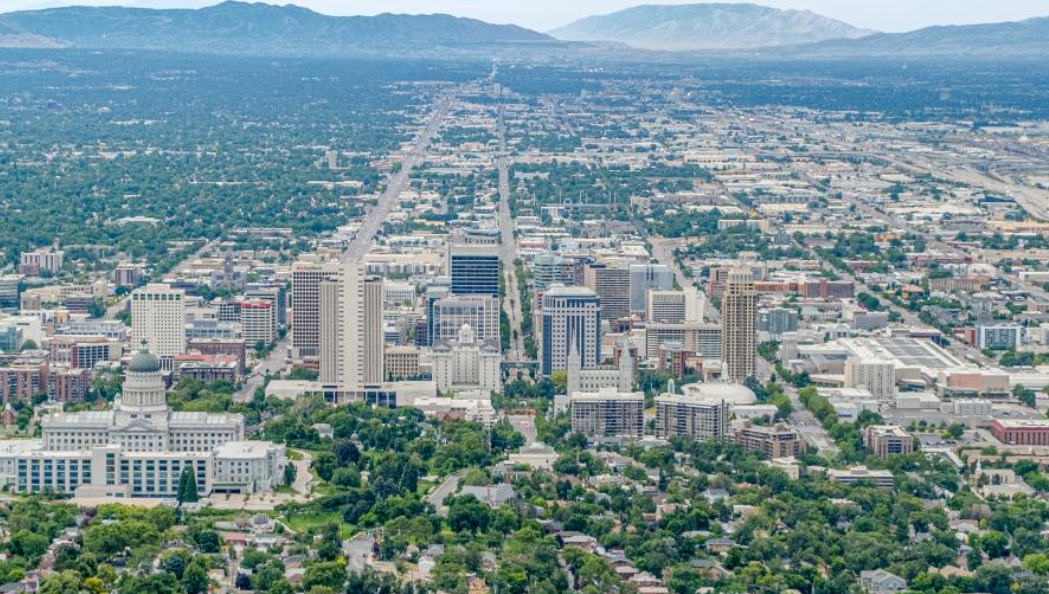
Salt Lake City is preparing to host the Winter Games again in 2034, and significant redevelopment is underway to prepare for the event. This includes Smith Entertainment Group’s $3 billion redevelopment of the Delta Center and surrounding blocks, alongside Salt Lake County’s overhaul of the Salt Palace Convention Center. The county has already acquired 6.5 acres of Salt Palace land, with partial demolition expected as early as 2027, a project that may impact the nearby UMOCA.
A Legacy of Displacement
The current struggle to preserve Japantown mirrors the destruction the neighborhood faced decades ago. At its peak, Japantown was one of the largest Japanese-language hubs in the country, housing roughly 8,000 residents in a corridor that stretched from State Street and 700 West to South Temple and 300 South. The area was a dense network of homes, shops, restaurants, laundries, markets, and two Japanese-language newspapers.
In 1966, nearly all of the neighborhood was demolished to make way for the Salt Palace, a civic arena intended to support a bid for the 1972 Winter Olympics. While the 1972 bid failed—with the Games ultimately going to Sapporo, Japan—the destruction of the neighborhood was driven by federal urban renewal policies often described as "slum clearance." This era of redevelopment replaced a dense urban corridor with large-scale developments such as Abravanel Hall, the Delta Center, and the Gateway.
Preserving Cultural Continuity
Today, the remnants of Japantown are anchored by the Japanese Church of Christ and the Salt Lake Buddhist Temple on 100 South. These sites, which now function largely as commuter congregations, remain the heart of a community that has fought for decades to preserve its cultural footprint.
As the mural rises on the 15-story wall of the MESH building, it stands as a testament to the resilience of the Japanese American community. The project represents a collaborative effort between the Salt Lake City Arts Council, the Community Reinvestment Agency, and the Utah Non-Profit Housing Corporation to ensure that the history of Japantown is not lost to the shifting landscape of Salt Lake City.