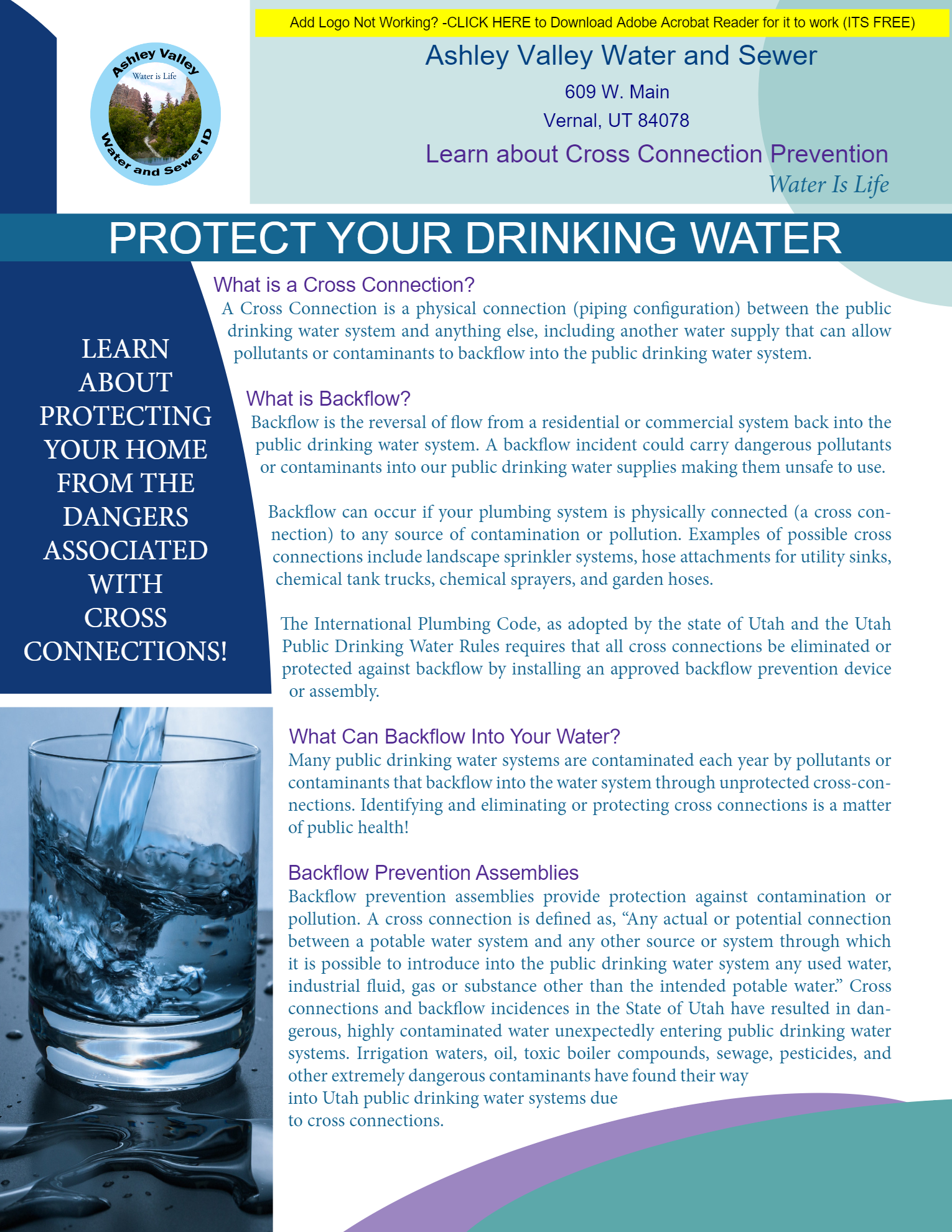
Ashley Valley Water and Sewer issued guidance on Wednesday, July 23, 2026, outlining essential steps for residents to prevent water contamination through cross-connections and identifying potential lead service lines within their properties. The utility's announcements focused on protecting the public drinking water system from pollutants like sewage, pesticides, and industrial fluids.
Risks of Backflow Contamination
The utility defined a cross-connection as any physical piping configuration that connects the public drinking water system to another supply. Such connections can allow contaminants to flow backward into the public system, a process known as backflow. According to Ashley Valley Water and Sewer, backflow occurs when there is a reversal of flow from residential or commercial systems back into the public supply.
A backflow incident can carry dangerous pollutants into the drinking water, making it unsafe for use. The utility noted that many public drinking water systems are contaminated annually by substances that enter through unprotected cross-connections. Examples of potential contaminants that have found their way into Utah public drinking water systems due to these connections include irrigation waters, oil, toxic boiler compounds, sewage, and pesticides.
Common Household Backflow Risks
Common household items often serve as the primary sources for these dangerous connections. The utility identified garden hoses as a major contributor to the majority of backflow incidents. To mitigate this, modern plumbing codes require that most threaded potable water outlets—including hose bibs or sill cocks—be protected by either an atmospheric vacuum breaker or a non-removable hose bib vacuum breaker (HBVB). The installation of an HBVB is described as an inexpensive method to prevent contamination via garden hoses.
Other high-risk areas include hand-held shower sprayers and similar attachments. If these devices are submerged in water, siphoning can occur, a problem that can be corrected by installing a special hose vacuum breaker. Additionally, the utility warned against using slip-on hose connections on kitchen or bathroom faucets, as these can defeat the protection provided by the built-in air gaps designed into those fixtures.
Protecting Utility and Plumbing Fixtures
The utility also highlighted specific plumbing components in laundry and utility areas that require attention. While washing machines are manufactured with built-in air gaps, utility sink faucets must be equipped with a hose bib vacuum breaker or an atmospheric vacuum breaker to prevent cross-connections.
Furthermore, the management of water softeners and toilets presents unique risks. Drain lines from water conditioners and softeners typically connect to sewer lines; therefore, an air gap must be maintained between the end of the drain line and the sewer line to prevent raw sewage from siphoning back into the drinking water. Regarding toilets, many units are equipped with ball-cock assemblies that do not meet current codes. These assemblies can allow water from the toilet tank to siphon back into the supply, requiring the use of anti-siphon ballcock assemblies for protection.
State and Plumbing Code Requirements
Compliance with state and international standards is a central part of the utility's prevention strategy. The International Plumbing Code, as adopted by the State of Utah and the Utah Public Drinking Water Rules, requires that all cross-connections be either eliminated or protected against backflow through the installation of approved prevention devices or assemblies.
This requirement extends to landscape sprinkler systems. Any system connected to the public water supply must be equipped with an approved backflow prevention device. Specifically, any sprinkling system capable of utilizing both secondary water supplies and public drinking water must follow strict plumbing regulations to ensure raw water does not enter the potable system.
Health Impacts of Lead Exposure
In addition to managing backflow, Ashley Valley Water and Sewer is actively working to identify and mitigate risks associated with lead in the water supply. The utility provides real-time information regarding its efforts to ensure lead-free drinking water and allows residents to interactively view progress on the documentation and replacement of copper, lead, and galvanized pipes.
Lead exposure poses significant health risks, as it can affect nearly every organ and system of the human body. According to the utility, high levels of exposure may cause anemia, weakness, kidney damage, brain damage, and nervous system damage. The utility emphasized that very high exposure can be fatal, noting that infants and young children are particularly vulnerable. In children, lead exposure can result in reduced IQ, attention spans, learning disabilities, hyperactivity, behavioral problems, and impaired growth.
Lead Identification and EPA Compliance
To assist in the mitigation of lead risks, the utility has launched a customer service line survey. Residents are encouraged to complete this survey to help identify whether they have lead pipes on the inside of their properties. Identifying these lines is critical because lead typically enters drinking water when pipes and plumbing fixtures corrode, particularly in environments with low mineral content or high acidity.
This effort aligns with requirements from the Environmental Protection Agency (EPA), which mandates an inventory of material types for all public and privately owned service lines. This inventory must classify all lines as lead, non-lead, galvanized steel needing replacement, or other materials. The completed inventory serves as a foundational starting point for much larger Lead Service Line Replacement programs.