Community July 31, 2026
Campus history worth preserving Fort Douglas is a living record of Utah and American military history that continues to shape the University of Utah.
Heather L. King - Associate Director of PR & Communication
Few people realize what remarkable history is around every corner of the University of Utah campus thanks to Fort Douglas.
The fort’s buildings and grounds are a physical record of U.S. and state history—first as a western outpost of the federal government prior to Utah’s statehood, then as a training ground for soldiers going to war, and finally as a home for reservists.
Once stretching over 10,500 acres along Salt Lake City’s east bench, Fort Douglas served as a living monument and land conservation tract over its 164-year history, providing much of the hillside acreage for the university’s growth and the community’s cultural and recreational spaces. Now, with the last 50 acres of active military land transferring to the university on Aug. 8, university leaders are committed to preserving the historic character of the place.
“As we accept stewardship of this historic place, we do so with a commitment to honor its past while creating new opportunities for future generations through education, discovery, health care and innovation,” President Taylor Randall said.
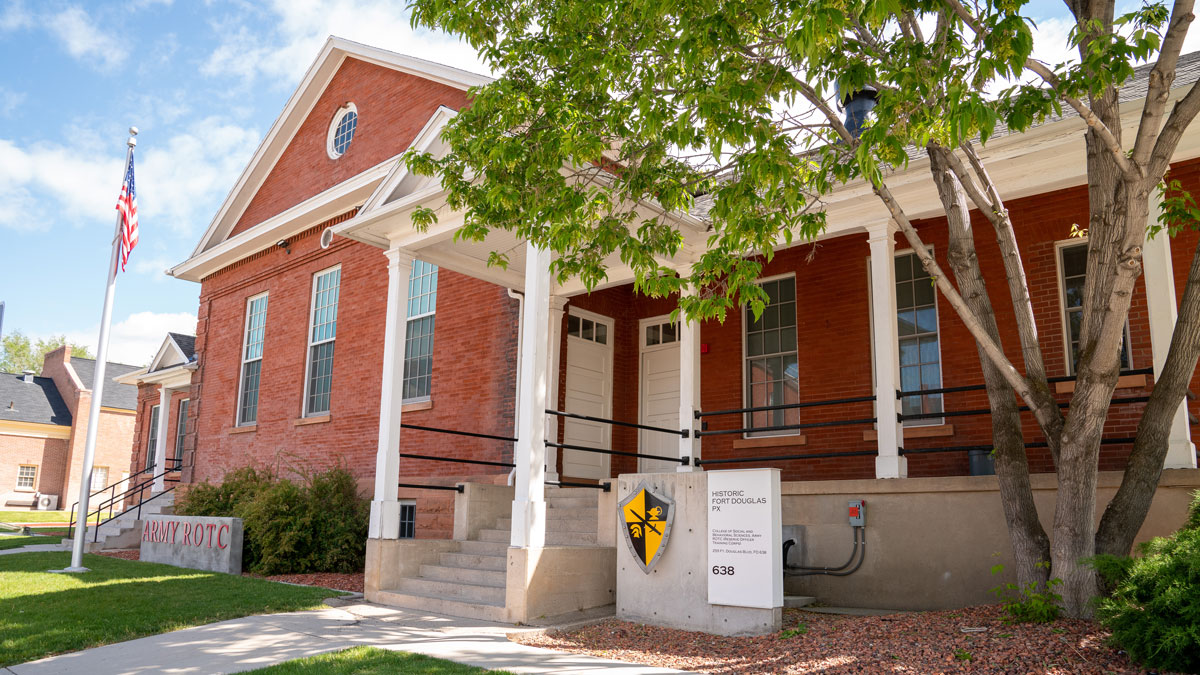
Today, the entirety of Fort Douglas property is on the National Register of Historic Places and the State Historic Register. Yet most people walk around the U campus without realizing its significant role in American history.
People and places that impacted America
The fort served as a World War I mobilization center, managed communications throughout the Pacific Theater during World War II and housed German and Italian prisoners of war.
During World War II, Fort Douglas became one of the most important military installations in the West.
“A lot of the Pacific Theater was coordinated and communicated from Fort Douglas,” Chris Merritt, Utah’s state historic preservation officer, said as he pointed toward the old bakery building below Stillwell Field during a tour of the area. “That’s where much of the communications for Iwo Jima and Guadalcanal [the first major land victory against Japan] were routed.”
Fort Douglas stables (building 101)
The historic stables (building 101) located off Soldier’s Circle were built in 1886 out of red sandstone. The gable-roofed structure measuring 37 feet wide and 303 feet long housed 96 of the fort’s cavalry and draft horses.
Building 655 is the oldest building on campus and the last remaining structure from the original Camp Douglas. Built in 1863, it served as the post commander’s residence and was regularly inhabited by military personnel until 1979.
Beyond just the historic buildings, what happened on the land before it became the U is just as intriguing.
Stillwell Field, now used for green space and recreation by students, was once the fort’s parade ground surrounded by barracks, hospitals, stables and officers’ quarters.
University of Utah students sitting on the lawn in the Historic Fort Douglas section of campus.
“This is the oldest designated open space in Utah,” Merritt said. “It predates any city parks.”
During World War I, troops trained there before heading overseas.
Fort Douglas also became home to the Buffalo Soldiers of the 24th Infantry Regiment in the 1890s.
“Most people don’t know about Black soldier history here,” Merritt said.
Their arrival sparked fear among some white residents of Salt Lake City. Chaplain Allen Allensworth, one of the Army’s first Black chaplains, helped change that. He hosted dinners and preached to soldiers regardless of race, organized community events and helped build relationships between Black soldiers and the broader community.
The regiment’s band performed concerts and its baseball team competed against local clubs. Because Fort Douglas was federal land, Sunday baseball games—prohibited elsewhere—could be played here.
The U preserves the past as part of its future
With the land the U now occupies coming from the decommissioning of Fort Douglas and the Base Realignment and Closure process, Congress transferred hundreds of acres and dozens of historic buildings to the university in 1990.
The gift came with an important condition. University leaders are committed to preserving the historic character of the place. Federal preservation laws will guide the process, along with oversight from the State Historic Preservation Office.
“The university’s getting an amazing deal on land and buildings,” Merritt said. “They’re just required to preserve them.”
Leading up to the 2002 Winter Olympics, the university injected new life into the many historic buildings to meet university needs as well as those of world-class athletes. Bringing old and new together at the Olympic Village at Fort Douglas, the long history at the fort was preserved while the village provided a thoughtful solution not only for the Olympics in 2002, but also for future generations at the U.
The National Trust for Historic Preservation recognized the university’s renovation of 26 buildings (primarily historic military housing quarters) that hosted the Olympic Athletes Village with its National Preservation Honor Award. And the Utah Heritage Foundation gave the school several awards at the 2002 Utah Historic Preservation Conference. In 2026, the university won Preservation Utah’s Rehabilitation and Restoration Award for three historic home renovations.
Fort Douglas Post Chapel
The Post Chapel, Officer’s Club, Commander’s Residence, and the Post Theatre all received individual awards for extraordinary preservation.
“The best use of historic buildings is to use them,” Merritt said.
University planners envision expanding on this stewardship responsibility again by creating additional student housing, support services, offices and additional parking with the final 50 acres of Fort Douglas that the U will receive from the U.S. Army Reserve on Aug. 8.
The U’s campus master plan incorporates the whole of Fort Douglas into a developing multi-use neighborhood called “College Town Magic” that will become the center of student life. Many of the historic barracks are expected to be rehabilitated to preserve their historic character while supporting the U’s growing campus with housing, recreation facilities, a secondary student union building, retail shops and food.
“We know that this significant military campus will again play prominently in the 2034 Olympic Games with more investment in preserving the historic fabric of Fort Douglas while ensuring the buildings and their 160 years of history will serve a purpose for the next generation,” said the State Historic Preservation Office.
As the U continues to transform historic Fort Douglas land, the university will continue to share the stories embedded in the land and its buildings. From Civil War-era structures and Buffalo Soldiers to World War II communications and Olympic history, Fort Douglas offers a rare connection to Utah and America’s past. By preserving the character of these historic places and putting them to modern use, the U can ensure that the remarkable history surrounding campus remains an important part of its future.