Fervo Energy's first quarterly report as a publicly traded company focused more on massive capital deployment and infrastructure development than on its reported $61,000 in first-quarter revenue. The results indicated a convergence of public-market capital, global project-finance lenders, and hyperscale electricity demand centered around geothermal infrastructure in Beaver County, Utah.
Following its initial public offering on the Nasdaq Stock Market on May 14, 2026, Fervo Energy raised approximately $2.2 billion in gross proceeds by issuing 80.5 million shares of Class A common stock. Additionally, the company closed $421.4 million in non-recourse project financing for Cape Station Phase I during the quarter. This financing, which included participation from Barclays, BBVA, HSBC, MUFG, and Société Générale, as well as RBC, J.P. Morgan, and Sumitomo Mitsui Trust Bank, is noted as a potential first for an enhanced geothermal systems project globally.
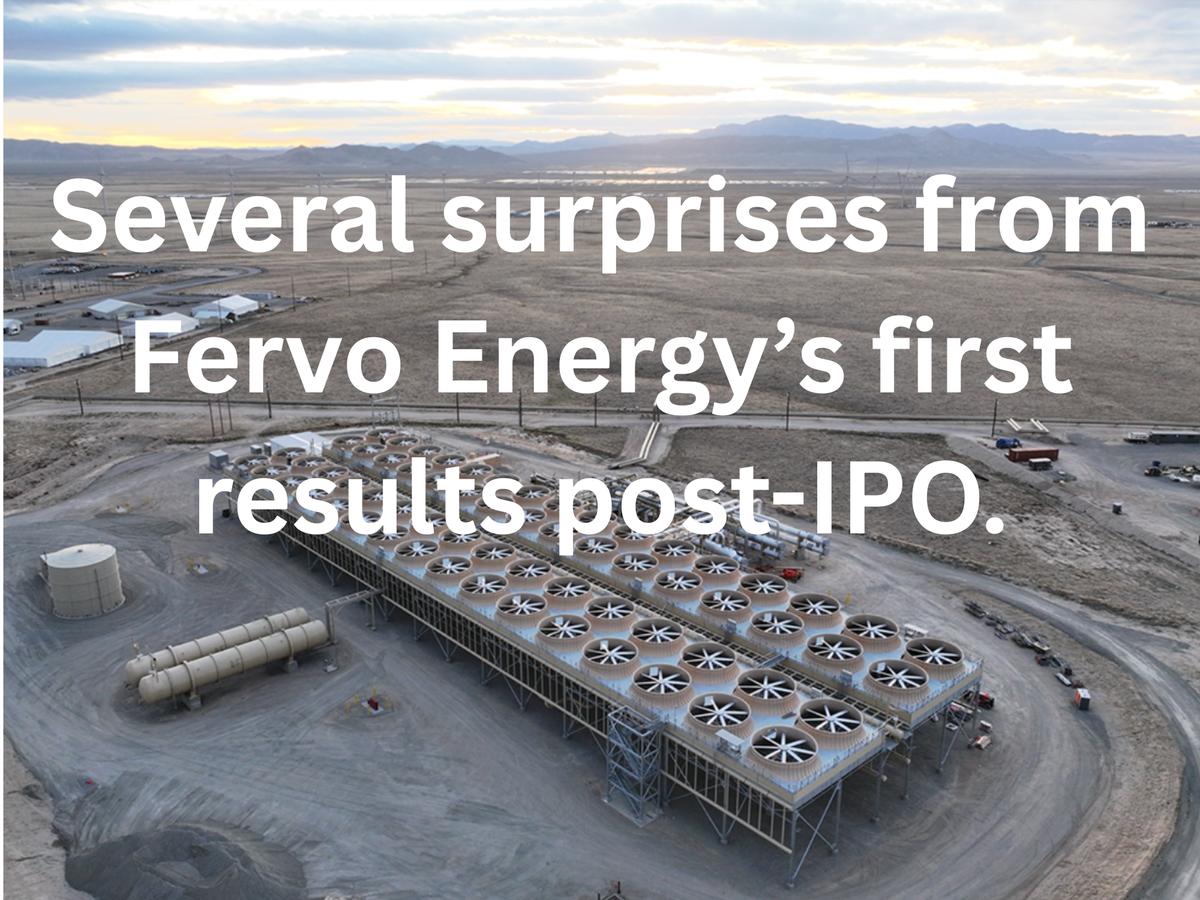
In Utah, the company's Cape Station project is a central focus. Phase I of the facility is expected to deliver approximately 100 megawatts in 2026, with plans to scale production to over 500MW in the near future. Construction of Cape Station Phase II began during the first quarter and is expected to deliver approximately 400MW with commercial operation targeted for 2028. To support these developments, Fervo expects to spend roughly $1.2 billion in Capital Expenditure from the second quarter of 2026 through the first quarter of 2027, primarily allocated to Cape Station and other GeoClusters.
The demand for clean, firm power is also driving interest in the sector. Fervo Energy announced a geothermal framework agreement with Google in March 2026 to support the development of up to 3GW of geothermal capacity through 2033. This agreement includes 1GW of proposed projects within the first two years.
Local resource validation also remains strong. The company reported that its Cottonwood observation well at Blanford, Utah, reached 555 degrees Fahrenheit at 11,200 feet, marking the hottest well in the company's history. This development occurs as the company attempts to transition enhanced geothermal systems from venture-backed technology into bankable, lender-financed infrastructure.
While Fervo Energy reported an operating loss of $20.1 million and a net loss of $31.8 million for the quarter, the company's recent activity highlights a significant shift toward physical energy asset conversion. The scale of capital deployment in Beaver County suggests the region is becoming a critical testing ground for whether geothermal power can function as large-scale, financeable infrastructure.