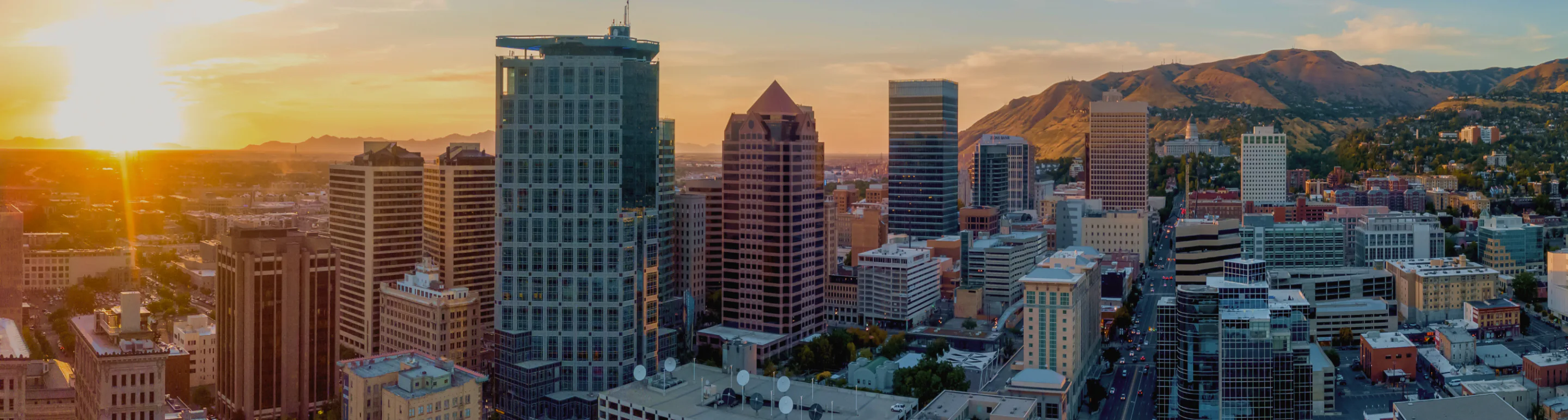
A third Democratic candidate has entered the race for Utah's newly drawn 1st Congressional District, following a judicial ruling that significantly altered the state's political landscape. The move comes as Utah prepares for the 2026 midterm elections, which will be the first held under a court-ordered congressional map that transformed the 1st District into a Democratic-leaning seat covering much of Salt Lake County.
A Crowded Democratic Primary
The Democratic primary for the 1st District, held on June 23, 2026, featured Nate Blouin, Michael Farrell, Ben McAdams, and Liban Mohamed. As of April 2026, Blouin, McAdams, and Mohamed were identified as leaders in fundraising and local media attention, according to Ballotpedia. The race is characterized by a divide between different factions of the Democratic Party, specifically between moderate pragmatists and a rising generation of progressive idealists.
Candidate Profiles and Platforms
The candidates represent diverse political backgrounds and approaches. Nate Blouin, who was elected to the Utah Senate in 2022 and previously worked as a renewable energy advocate, has campaigned on a platform of fighting corporate lobbyists and investigating ICE facilities. Ben McAdams, an attorney and former Salt Lake County Mayor from 2013 to 2019, previously represented Utah's 4th Congressional District from 2019 to 2021. Liban Mohamed, an advocate and policy analyst who has worked for the American Heart Association, Meta, and TikTok, advanced to the primary after the Utah Democratic Party's nominating convention held on April 24-25, 2026. Michael Farrell also secured a place on the primary ballot by submitting 7,000 signatures.
Redistricting and Legal Battles
The shift in district boundaries is the result of protracted legal battles over partisan gerrymandering. On November 10, 2025, Judge Dianna Gibson ordered the adoption of a new U.S. House map after ruling the previous process unconstitutional. This decision followed a series of challenges to Utah's maps. On August 25, 2025, a trial court had granted summary judgment to plaintiffs, restoring the independent redistricting commission created by a 2018 citizens' initiative known as Proposition 4. However, the legislature had previously attempted to relegate that commission to an advisory role in 2020. The Democratic National Committee, in a statement released on November 11, 2025, described the court's decision to choose a fair, impartial map as a victory for democracy and a thwarting of Republican efforts to maintain power through gerrymandering.
Impact of New District Lines
The new district's composition has significant implications for the state's representation. According to reporting by Inside Elections, the new 1st District is now a Democratic-leaning seat. Data shows that former Vice President Kamala Harris would have carried the district by 24 percentage points in the 2024 presidential election. This shift highlights the changing demographics and political alignment within the region, particularly in Salt Lake County.
Voter Registration Statistics
The political landscape in Utah remains predominantly Republican. According to voter registration statistics updated on August 3, 2026, there are 1,028,647 registered Republicans and 295,514 registered Democrats in the state. Unaffiliated voters represent the largest single group with 625,762 registered individuals. The voter data from 2019-01-22 shows a similar partisan divide, with 914,191 Republicans and 249,603 Democrats registered at that time.
Looking Toward the General Election
As the 2026 general election approaches on November 3, 2026, the competition within the Democratic Party is intensifying. Weber State University professor Leah Murray noted that because there is limited policy difference between the candidates, they must find ways to distinguish themselves to voters. This internal competition is expected to shape the party's direction in Utah as they vie for the newly accessible seats in the House of Representatives.