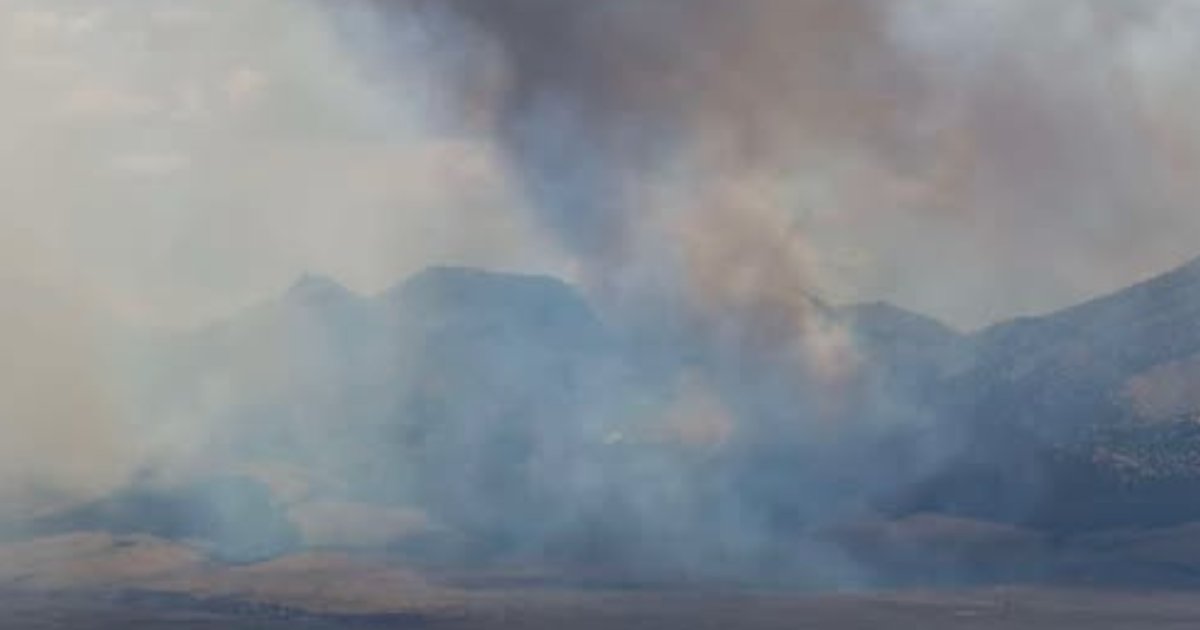
Confronting Great Salt Lake’s dust dilemmas
Published 03-07-25
SALT LAKE CITY (March 7, 2025) — The Utah Division of Water Resources has been hard at work on the Great Salt Lake Basin Integrated Plan for a little over a year now, and a handful of its projects are in full swing. The integrated plan — funded with $5 million by the Utah Legislature in 20lag22 (HB 429) and $3.1 million from the Bureau of Reclamation’s basin study program — aims to ensure a resilient water supply for Great Salt Lake and all water uses, including people and the environment, throughout the watershed. The research projects that make up the integrated plan range from groundwater well monitoring, to identifying water requirements for shorebirds and a lot more in between. Once complete, the integrated will be a robust planning tool that will inform future water management decisions within the basin.
Focus on dust research
One key element of the integrated plan — and the project we want to focus on today — is dust research.
Current knowledge of dust
Dust: what do we know?
Thanks to existing research by the Department of Atmospheric Sciences and University of Utah and ongoing monitoring by the Utah Division of Air Quality, we know some about dust in the Great Salt Lake Basin already. As Great Salt Lake has retreated, over 800 square miles of lakebed have been exposed. When the surface dries and strong winds pick up, dust plumes frequently rise from the exposed lakebed and drift into nearby communities. These dust hotspots are most common in areas where the protective crust has eroded, vegetation is sparse or absent, and fine particles like silt and clay are abundant.
Sources: Google Earth Pro 7.3. (2024). Great Salt Lake; Perry, K. (2024). Department of Atmospheric Sciences, University of Utah.
These dust plumes can impact air quality and accelerate mountain snowmelt across the basin. With more than 2.66 million residents living downwind, the dust poses health risks: both from elevated PM10 (particulate matter with a diameter of 10 micrometers or less, also known as large dust particles) levels and chronic exposure to carcinogenic elements like arsenic.
Sources and movement of dust
Where is the dust coming from?
Dust hotspots exist across all four quadrants of Great Salt Lake, but they’re most common in Farmington and Bear River Bays where rivers deposit fine sediments. Up to 76% of the lakebed is naturally protected by surface crusts, but these are fragile and easily damaged by erosion or human activity. If lake levels remain low, dust emissions will likely become more frequent and severe.
How does dust travel?
Most dust storms occur when cold fronts move through, with strong south/southwest winds lasting 12-18 hours, followed by a wind reversal lasting 3-6 hours. This means all communities in the Great Salt Lake Basin are downwind at some point.
How long does it stay in the air?
Large dust particles (PM10) settle within hours to days, while smaller particles (PM2.5) can stay suspended for up to two weeks and travel thousands of miles before being cleared by rain.
How fast does it reach cities?
Winds over 25 mph can carry Great Salt Lake dust to Salt Lake, Davis, Weber, Tooele and Box Elder Counties in under an hour and to Cache and Utah Counties within two hours.
As dust events become more frequent, understanding these patterns is crucial for air quality and public health.
Many thanks to the Great Salt Lake Strike Team for compiling and publishing this dust data in the Data and Insights summary that went online in January 2025.
Future research and discovery
Dust: more to discover
The integrated plan-funded dust project has updated the dust hotspot elevation distribution and expanded the study area for the 2016 Great Salt Lake dust exposure model, focusing on areas above 4194.5 feet. As the lake’s elevation dropped to 4188.5 feet in November 2022, new dust hotspots were identified. University of Utah researchers used updated data to revise the hotspot database and determined the elevations of these new hotspots using bathymetry (the measurement of depth of water).
Next steps for the project
What’s next?
The next phase of the project will incorporate dust hotspots into the model and run through a range of lake level scenarios. The study will also explore dust mitigation strategies and their associated costs, as well as the potential health implications and costs of lakebed dust.
Ongoing collaborative efforts
What else is in the works?
In addition to the division’s efforts, several other entities are working to address Great Salt Lake dust issues. The Office of the Great Salt Lake Commissioner made a list of priorities following a forum that focused on impact of dust on air, land and water and highlighted research gaps and opportunities for further study.
Many of these priorities — listed here with a designated lead agency and funding timeline — encompass a lot of research and management areas and build on existing and ongoing efforts.
Dust priorities from the Office of the Great Salt Lake Commissioner
Invest in an improved monitoring network for dust including both particulate matter and filter monitors (Division of Air Quality, FY26).
Invest in additional research into surface crust dynamics, dust-associated contaminants and dust hot spots (Division of Forestry, Fire and State Lands — Tech Team, FY26).
Leverage and invest in remote sensing to be able to estimate and monitor crust and hot spot development, and identify areas for and monitor the effectiveness of mitigation (Division of Forestry, Fire and State Lands — Tech Team, FY26).
Develop models to help characterize and differentiate dust from Great Salt Lake and other sources (i.e. West Desert, Sevier Dry Lake, gravel pits) (Division of Air Quality, FY26).
Identify and test cost-effective mitigation measures while working to secure enough water to get the lake to the healthy target range (Division of Water Resources – GSLBIP to study mitigation measures, FY25 and Division of Forestry, Fire and State Lands — Tech Team to fund pilot projects, FY26).
Develop real-time public education tools (Commissioner’s Office and Division of Water Resources, FY25).
Utilize quarterly Great Salt Lake dust meetings to provide feedback on studies and implementation including monitoring plans and modeling (Division of Air Quality and Commissioner’s Office, FY25).
The Utah Division of Water Resources is proud to be part of the critical work addressing dust pollution from Great Salt Lake. Alongside partners, we are gaining valuable insights into dust emission patterns and exploring potential solutions. As we move forward with refining dust exposure models and investigating cost-effective mitigation strategies, we are committed to helping reduce the health and environmental impacts of dust. With continued focus on research, monitoring and effective solutions, we look forward to contributing to a more resilient future for Great Salt Lake and the surrounding communities.
Learn more about the integrated plan on the Utah Division of Water Resources website and explore additional collaborative efforts by visiting GreatSaltLake.utah.gov.