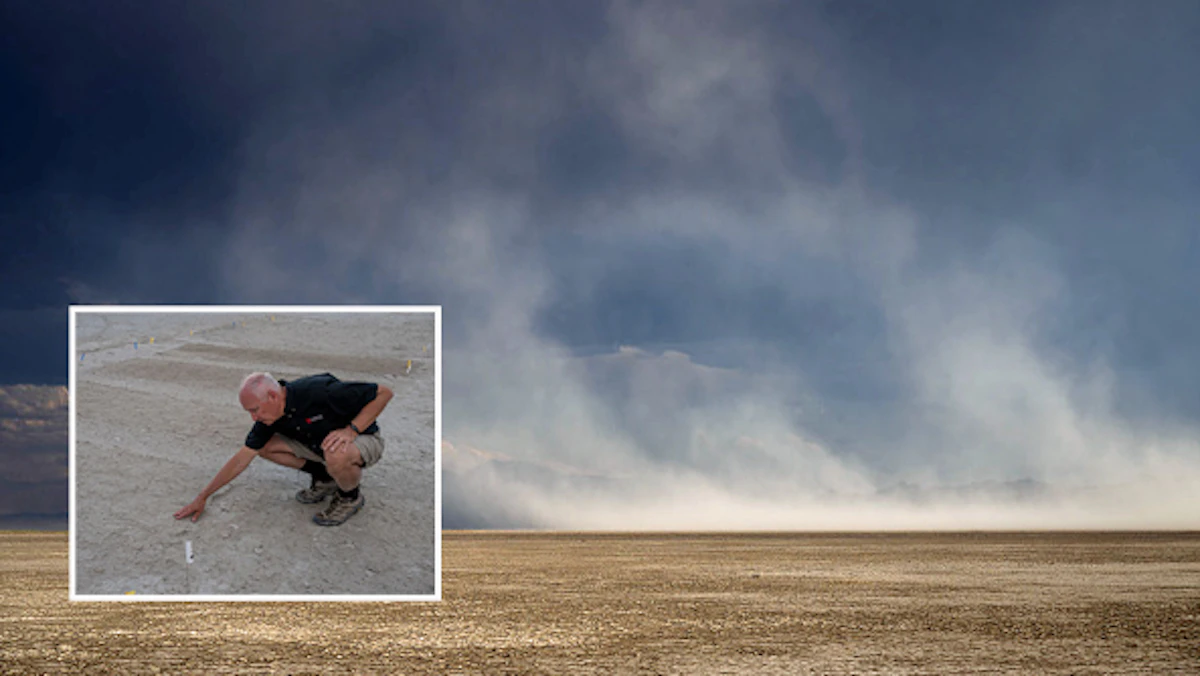
A shrinking Great Salt Lake is exposing hundreds of square miles of lakebed to the wind, raising concerns among Utah scientists that dust carrying potentially harmful materials could spread into neighboring states, including southwestern Wyoming.
In a report published August 14, researchers noted that the dust could potentially impact areas such as Evanston. However, Wyoming officials stated there is currently no evidence that Great Salt Lake dust is affecting Wyoming's air quality.
Atmospheric scientist Kevin Perry of the University of Utah stated that dust storms, such as one occurring on July 8, cause spikes in airborne particulate matter. These spikes can potentially lead to respiratory issues, particularly for individuals with asthma or chronic obstructive pulmonary disease. Perry noted that strong winds from the south and southwest can carry dust from the exposed lakebed north and east toward southwestern Wyoming.
The Great Salt Lake has been shrinking for approximately four decades, exposing more than 800 square miles of lakebed, according to Perry. Ben Abbott, an ecologist at the University of Utah, said the decline of more than half the lake is largely due to water being diverted for agriculture and communities throughout the watershed. Abbott stated that water usage in neighboring Wyoming and Idaho has also contributed to the depletion.
Researchers have identified minerals and metals in the dust, including salt, aluminum, iron, silicon, and titanium. Abbott noted that while larger particles generally do not travel far, smaller particles can remain airborne for significant distances. This has led to concerns regarding metals that could pose health risks with prolonged exposure.
The Wyoming Department of Environmental Quality (DEQ) monitors air quality for various pollutants but is not specifically monitoring Great Salt Lake dust as an air-quality issue. Jillian Scott, a spokesperson for the DEQ, told Cowboy State Daily that the agency has not observed information indicating impacts in Wyoming related to the dust and lacks the data to confirm such claims.
Scott explained that it is difficult to source specific pollutants unless they are in the general vicinity. Confirming a connection would require specialized analysis, such as collecting air filters during a dust event to compare samples with known Great Salt Lake dust profiles, which is not part of the standard monitoring program.
The environmental situation has reached a level of concern that is reflected in President Donald Trump’s 2027 budget proposal, which includes a $1 billion request for a federal program to address toxic dust and stabilize the shrinking lake.
Abbott suggested that the situation mirrors the history of the Aral Sea in Central Asia, where the loss of water led to exposed contaminated lakebeds and increased rates of cardiovascular disease and cancer. Utah is currently establishing a network of dust monitors to better understand the frequency, distance, and contaminant levels of the airborne particles, with the network expected to be completed by early spring 2027.