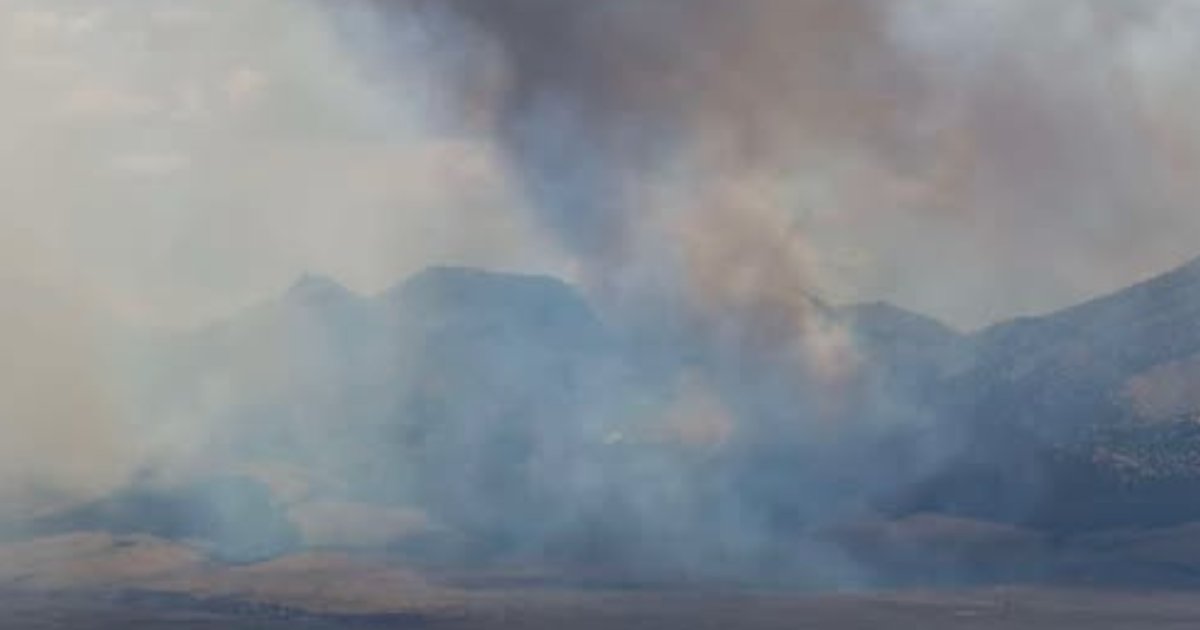
HERRIMAN — Firefighters will often say wildfire danger is high, but they don’t always say why it’s high.
Identifying the wildfire culprit
On Tuesday, a Unified Fire Authority wildland team toured a KSL crew around an area at the mouth of Butterfield Canyon to explain what is so concerning to the team about the current fire conditions.
There, Greg Vander Werff quickly pointed to the purple-colored cheatgrass that surrounded him.
Cheatgrass is pictured near the mouth of Butterfield Canyon in Herriman on Tuesday. (Andrew Adams, KSL)
“This is kind of an example of what we are up against in a dry wildland season,” Vander Werff, a firefighter and paramedic with UFA, said. “This is really the culprit.”
The danger of cured cheatgrass
Werff said the purple color is something firefighters are used to seeing in these wildland areas later in June or in July.
Instead, it was only May.
“You can see how some of the parts are green, and then other parts are purple,” Werff explained as he grabbed a handful of the cheatgrass. “When it’s purple, that means it’s cured, and it’s drying and it’s ready to burn.”
He outlined the scenario fire teams don’t want to see.
“Cheatgrass cures, it gets really dry, ignites the ladder fuels, ignites the trees then it makes a run,” Werff said.
High risk across Salt Lake Valley
He said the conditions were consistently dry, like on hillsides and in other wildland areas around the Salt Lake Valley.
“It just primes the entire county for very high wildfire risk,” Werff said. “Every 24 hours, we’re evaluating what the risk is in the county.”
Department preparation and training efforts
Werff said the department was doing all it could to be ready, from operating a wildland specialty station in Herriman and employing a specially trained wildland “duty officer” at all times to assess fires as they start, to ensuring firefighters in the department have the proper wildland training.
(Andrew Adams, KSL)
He said UFA firefighters recently completed 3,500 combined hours of wildland training.
Public prevention and safety tips
Firefighters urged the public to do what they can in the weeks to come to reduce the risk of fires by not parking on dry brush and ensuring vehicles are maintained properly and are not dragging things like chains.
Werff also urged homeowners to mow fuels around their properties.
“It doesn’t take much at all,” he said of the potential to start a significant wildfire. “When it gets hotter and dryer, it’s going to be off to the races.”
Related: Memorial Day prescribed burn drops ash across Davis County
Follow @KSL5TV
Like us on Facebook