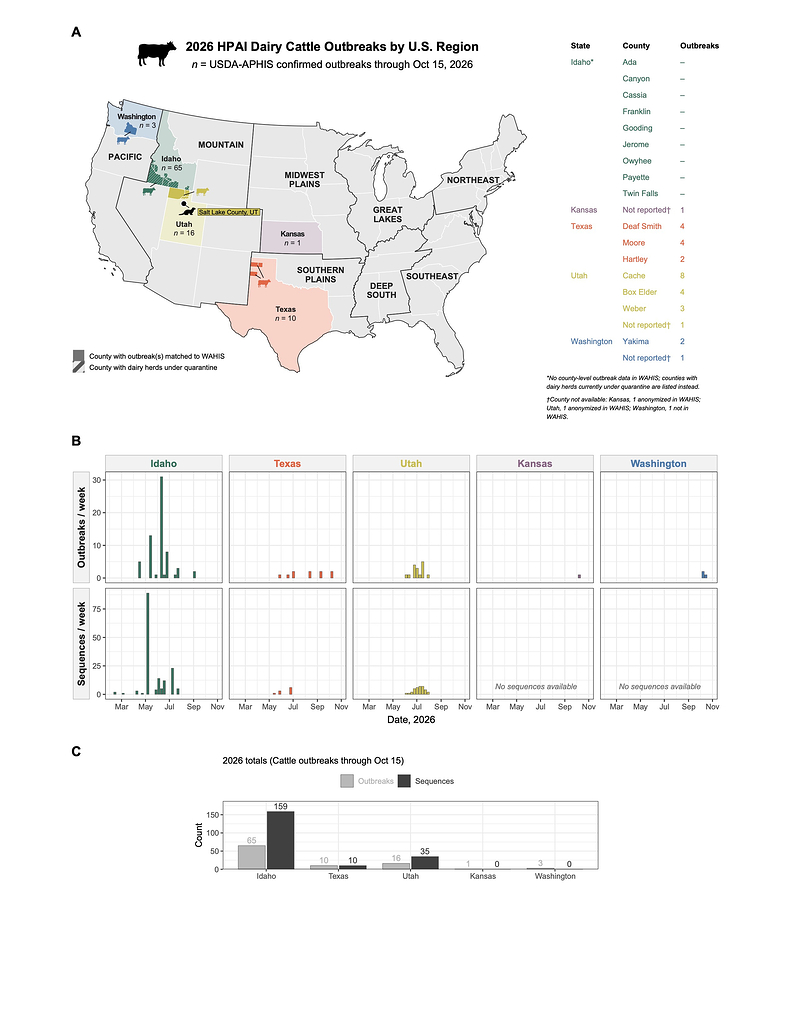
An outbreak of highly pathogenic avian influenza H5N1 clade 2.3.4.4b was detected in captive mink in Salt Lake County, Utah, in August 2026. According to a report published October 22, the outbreak involved the B3.13 genotype, a strain currently circulating in dairy cattle across the United States.
The H5N1 was detected via PCR on August 17, 2026, by the USDA Animal Plant Health Inspection Service National Veterinary Services Laboratories. The samples analyzed for the study were collected from the mink on August 7, 2026. Genetic sequencing of the ten mink viruses identified the genotype as B3.13, which has also been reported in dairy cattle in Utah, Texas, and Idaho during 2026.
Phylogenetic analysis positioned the Utah mink outbreak within the 2026 cattle clade. While the B3.13 virus has been reported in dairy cattle in three other northern Utah counties in 2026, no H5N1 outbreaks have been reported in dairy cattle specifically within Salt Lake County. The most closely related viruses to the Utah mink samples were sampled in May 2026 in Texas cattle, though a three-month gap exists between those samples and the August 2026 detection in Utah.
The identified B3.13 lineage already possesses the M631L mutation in the PB2 gene, which increases viral replication in mammals. However, all ten Utah mink viruses exhibited a PB1-K388R substitution, a mutation rarely seen in avian hosts but previously observed in an H5N1 mink outbreak in Spain in 2022. Researchers noted that the Utah mink viruses appear to be evolving at a standard rate for influenza, with no evidence that the virus has been preserved in a non-replicating frozen state.
As of September 29, 2026, the outbreak was reported as ongoing at the Utah mink farm. While the outbreak appears contained to a single farm, researchers noted that local spread remains a concern and that there are currently no plans to cull H5N1-infected mink in Utah.