The Grand County Commission serves as the primary governing body for Grand County, the jurisdiction that encompasses the city of Moab. While the specific procedural bylaws and meeting frequencies are not detailed in the provided records, the commission plays a central role in regional oversight and high-level discussions regarding local infrastructure and land use.
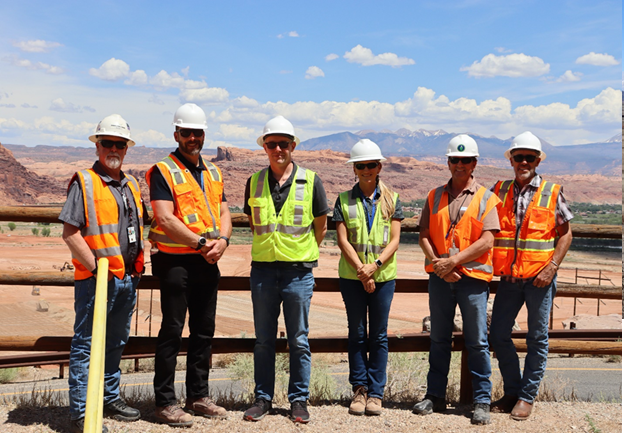
Leadership within the commission includes a Chair, a position held by Bill Winfield. As the governing body, the commission engages with various stakeholders on complex environmental and legislative matters. For example, according to a Department of Energy report, Commission Chair Bill Winfield participated in a tour of the Moab Uranium Mill Tailings Remedial Action Project on June 11, 2025. This tour, which included U.S. Rep. Mike Kennedy, focused on the U.S. Department of Energy Office of Environmental Management (EM) cleanup site.
Legislative interests involving the commission often intersect with federal policy. In April, Congressman Kennedy co-sponsored the Moab UMTRA Project Transition Act of 2025 alongside Utah Sen. John Curtis. This specific piece of legislation seeks to transfer the property of the Moab Project site to Grand County once the current cleanup process reaches completion. This highlights the commission's role in planning for the future of local land following large-scale environmental remediation efforts.
Beyond environmental management, the commission is involved in discussions regarding regional transportation and funding. According to a newsreel from KZMU Moab Community Radio, the commission has held discussions regarding Arches Shuttle funding. Such discussions are vital to the local economy and the management of the area's significant natural landmarks.
Residents can engage with the commission through public discourse and by following local media reporting on their proceedings. Local news outlets, such as the Moab Sun News, monitor the commission's actions, including their deliberations on funding and regional projects. This ensures that the discussions held by the commission remain a part of the public record and a point of interest for the community.
The commission operates as a bridge between federal agencies, such as the Department of Energy and the Bureau of Land Management, and the local community. This relationship is evident in the ongoing collaboration required to manage contaminated groundwater and the placement of residual radioactive materials in disposal cells. As the Moab Project moves toward completion, the commission remains a key stakeholder in planning for the future of the site. Through its oversight of regional funding and its role in legislative transitions, the Grand County Commission remains a foundational element of local governance for the 5,366 residents of Moab.
What this means for Moab
For Moab residents, the Grand County Commission acts as a vital link between federal environmental projects and local land ownership. Their decisions regarding shuttle funding and the eventual transfer of remediated lands will shape the physical and economic landscape of the region for years to come.