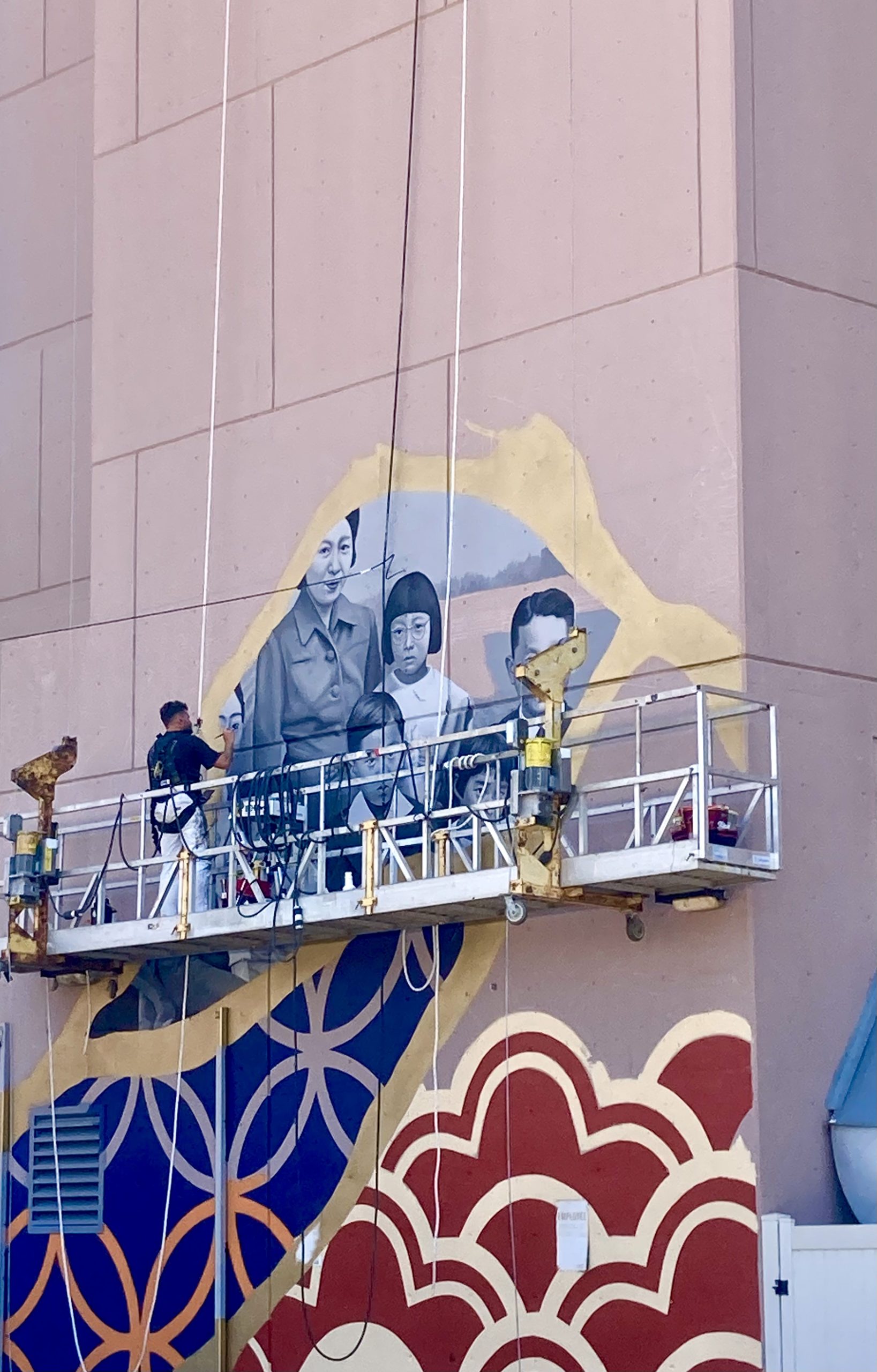
Work has commenced on a new mural in Salt Lake City's Japantown, created by Northern Utah muralist Cole Eisenhour. The project began on July 11 during the Salt Lake Buddhist Temple’s Obon Festival, where community members participated by painting design elements.
Eisenhour is currently working on the side of the Multi-Ethnic Senior Highrise, located behind the temple at 211 West 100 South. The mural features black-and-white archival portraits rising from a gold crack in pink concrete, framed by deep blue asanoha and red seigaiha wave patterns.
The design utilizes the concept of kintsugi, a Japanese practice of repairing broken pottery with gold to highlight rather than hide breaks.
The mural is funded by the Salt Lake City Public Art Program and the Community Reinvestment Agency. Eisenhour, who grew up in Roy and studied at Utah Valley University, developed the design after meeting with Japanese American community members following his introduction to the neighborhood during the Nihon Matsuri in April.
Historically, Japantown was a significant corridor of homes, shops, and restaurants that once housed approximately 8,000 residents. The neighborhood saw growth from Japanese immigrants working in Utah's mines, farms, and railroads, as well as those moving to the area from internment camps like Topaz after World War II.
Much of the original neighborhood was demolished in 1966 to facilitate the construction of the Salt Palace for a 1972 Winter Olympics bid. This period of urban renewal replaced dense urban corridors with large-scale developments such as Abravanel Hall, the Delta Center, and the Gateway.
While the mural is underway, planned streetscape improvements for Japantown Street—including wider sidewalks and cherry trees—are currently paused. This pause is due to larger redevelopment projects tied to the 2034 Winter Games, including Smith Entertainment Group’s $3 billion project near the Delta Center and Salt Lake County's overhaul of the Salt Palace Convention Center.
Partial demolition of land for these projects is expected as early as 2027. Despite these shifts, the mural stands as a visible element of the area while the future of the surrounding streetscape remains in flux.